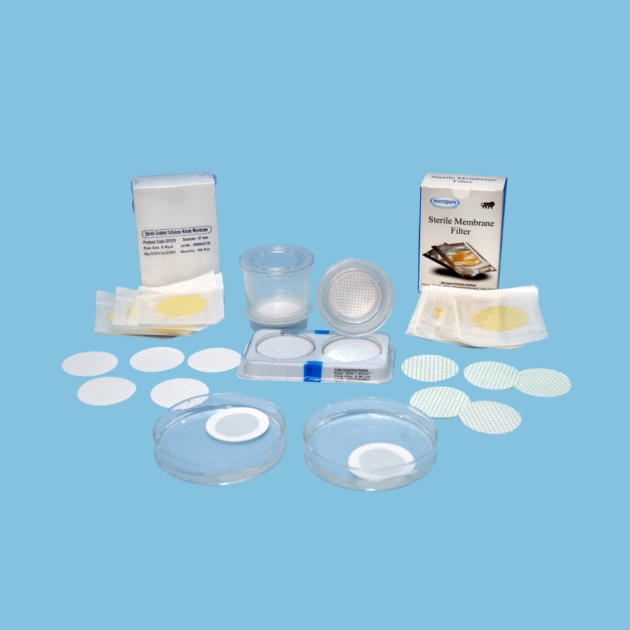

Description
Characteristics:
- Hydrophobic Edge Treatment:
- EHCN membranes have hydrophobic treatment applied to their edges, which repels aqueous liquids.
- This treatment helps prevent leakage and reduces the risk of cross-contamination during filtration and handling of liquid samples.
- Plain Cellulose Nitrate Properties:
- The main body of the membrane retains the properties of plain cellulose nitrate, including precise pore size distribution and chemical resistance.
- It provides effective filtration performance while the hydrophobic edge treatment enhances usability.
- Chemical Compatibility:
- Like other cellulose nitrate membranes, EHCN membranes are compatible with a wide range of solvents and chemicals commonly used in laboratory settings.
- They can withstand exposure to various reagents without compromising their integrity.
- Application-Specific Design:
- Designed for applications where edge effects from wicking of aqueous liquids could affect results, such as in microbiological analysis and environmental monitoring.
- Suitable for use in both research and industrial laboratories where precise sample handling and filtration are required.
Applications:
- Microbiological Analysis:
- Used in microbiology laboratories for filtering and counting microorganisms, particularly where avoiding edge effects is crucial for accurate results.
- Liquid Sample Filtration:
- Ideal for filtration of liquid samples in research and development, quality control, and environmental monitoring applications.
- The hydrophobic edges help contain samples within the membrane area, minimizing sample loss and ensuring accurate analysis.
- Biological and Chemical Assays:
- Applied in assays and experiments requiring precise filtration and sample preparation, where maintaining sample integrity is essential.
- Industrial Quality Control:
- Used in industrial settings for filtration processes where preventing sample leakage and maintaining process integrity are priorities.
EHCN membranes provide a practical solution for applications requiring reliable filtration while minimizing potential edge effects and sample leakage. Their hydrophobic edge treatment enhances usability and ensures accurate results in various laboratory and industrial environments.